Again They Always Been Junker Trucks When They Were Coming Out in the 70s
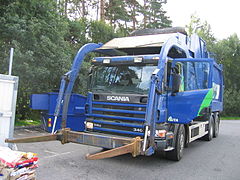
A garbage truck is a truck specially designed to collect municipal solid waste matter and transport information technology to a solid waste product treatment facility, such as a landfill, recycling center or transfer station. Other mutual names for this type of truck include trash truck in the U.s., and turn down truck, dustcart, rubbish truck, junk truck, bin railroad vehicle, dustbin lorry, bin lorry or bin van elsewhere. Technical names include waste matter collection vehicle and refuse collection vehicle (RCV). These trucks are a mutual sight in almost urban areas.
History [edit]

Thornycroft Steam Grit-Cart of 1897 with tipper body
Wagons and other ways had been used for centuries to booty away solid waste material. Among the outset self-propelled garbage trucks were those ordered past Chiswick District Quango from the Thornycroft Steam Wagon and Carriage Visitor in 1897 described as a steam motor tip-car, a new pattern of body specific for "the collection of dust and house pass up".[1]
The 1920s saw the offset open-topped trucks being used, but due to foul odors and waste product falling from the back, covered vehicles soon became more common. These covered trucks were first introduced in more densely populated Europe and then in North America, but were soon used worldwide.
The main difficulty was that the waste collectors needed to elevator the waste matter to shoulder height. The first technique developed in the tardily 1920s to solve this problem was to build round compartments with corkscrews that would lift the load and bring it away from the rear. A more efficient model was the development of the hopper in 1929. It used a cable organisation that could pull waste into the truck.
In 1937, George Dempster invented the Dempster-Dumpster system in which wheeled waste containers were mechanically tipped into the truck. His containers were known every bit Dumpsters, which led to the word dumpster entering the language.
In 1938, the Garwood Load Packer revolutionized the industry when including a compactor in the truck was implemented. The beginning compactor could double a truck'south chapters. This was made possible by utilise of a hydraulic press which periodically compacted the contents of the truck.
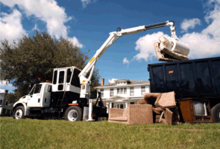
RS-3 Lightning Rear Steer truck
In 1955 the Dempster Dumpmaster, the first front end loader, was introduced. They didn't become mutual until the 1970s. The 1970s likewise saw the introduction of smaller dumpsters, often known as wheelie bins which were also emptied mechanically. Since that time in that location has been little dramatic change, although there have been diverse improvements to the compaction mechanisms to improve payload. In the mid-1970s Petersen Industries introduced the first grapple truck for municipal waste collection.
In 1969, the city of Scottsdale, Arizona introduced the earth's kickoff automated side loader. The new truck could collect 300 gallon containers in 30 2nd cycles, without the driver exiting the cab.[2]
In 1997, Lee Rathbun introduced the Lightning Rear Steer Arrangement. This system includes an elevated, rear-facing cab for both driving the truck and operating the loader. This configuration allows the operator to follow behind booty trucks and load continuously.
Types [edit]

Front loaders [edit]
Front end loaders by and large service commercial and industrial businesses using big waste material containers with lids known as Dumpsters in the US.[three] The truck is equipped with powered forks on the forepart which the driver advisedly aligns with sleeves on the waste container using a joystick or a ready of levers. The waste matter container is then lifted over the truck. Once it gets to the top the container is then flipped upside down and the waste product or recyclable material is emptied into the vehicle's hopper. In one case the waste is dumped, it is compacted past a hydraulically powered moving wall that oscillates backwards and forrad to button the waste product to the rear of the vehicle.[four]
About of the newer packing trucks have "pack-on-the-go hydraulics" which lets the driver pack loads while driving, allowing faster route times.[five] When the body is full, the compaction wall moves all the style to the rear of the body, ejecting information technology via an open tailgate. At that place is besides a system called the Curotto Can which is an attachment for a front end loader that has an automated arm that functions as an automated side loader that allows the driver to dump carts.

xiv.5 m3 rear load container serviced in Copenhagen
Garbagemen loading garbage past hand in Nippon, 2013
Rear loaders [edit]
Rear loaders take an opening into a trough or hopper at the rear that a waste material collector can throw waste product bags or empty the contents of bins into. Oft in many areas they take a lifting machinery to automatically empty large carts without the operator having to lift the waste past mitt.[vi]
Another popular system for the rear loader is a rear load container particularly congenital to fit a groove in the truck. The truck will take a chain or cable system for upending the container. The waste volition then slide into the hopper of the truck.
The modernistic rear loader usually compacts the waste using a hydraulically powered machinery that employs a moving plate or shovel to scoop the waste out from the loading hopper and compress it confronting a moving wall. In most compactor designs, the plate has a pointed edge (hence giving it the industry standard name packer blade) which is designed to apply signal pressure level to the waste to break down beefy items in the hopper earlier being drawn into the main body of the truck.
Compactor designs have been many and varied, however the two about pop in employ today are the "sweep and slide" system (first pioneered on the Leach 2R Packmaster), where the packer bract pivots on a moving railroad vehicle which slides back and along in large tracks made into the torso sides, and the "swing link" system (such every bit the Dempster Routechief) where the blade literally swings on a "pendulum"-fashion mechanism consisting of links which command the arc of the blade'south movement. The Geesink GPM series uses a pivoting packer blade which swings on an inverted U-shaped frame which lowers the blade into the hopper, where it sweeps the waste out; the frame then retracts back into the trunk to perform the compaction action. The Heil Colectomatic is a hybrid between the two philosophies- it used a combination of a lifting loading hopper and a pivoting sweeper blade to articulate and compact waste in anticipation of the side by side load.
So-called "continuous" compactors were popular in the 1960s and 1970s. The German Shark design (after Rotopress) used a huge rotating drum fitted with screw shaped paddles to draw waste in, and force it around an auger of decreasing pitch to compress it. SEMAT-Rey of France pioneered the rotating rake system (too used in the British Shelvoke and Drewry Revopak) to simultaneously shred and compress the waste every bit it is loaded. Other systems used a continuously rotating Archimedes' screw to draw in waste and mutilate information technology inside the body. A mixture of safety concerns, and higher fuel consumption has seen a decline in the popularity of continuously compacting garbage trucks, with only the Rotopress design remaining in production due to its niche in beingness able to effectively bargain with light-green waste for composting.
The wall will move towards the front of the vehicle as the pressure level forces the hydraulic valves to open, or every bit the operator moves it with a manual command.
A unique rear-loading arrangement involves a rear loader and a front-loading tractor (normally a Caterpillar front loader with a Tink Hook) for 1000 waste drove (and in some cities, garbage and recycling). The front loader picks upwards yard waste material set in the street, and then loaded into the back of a rear loader. This organization is used in several cities, including San Jose.
Side loaders [edit]
Side loaders are loaded from the side, either manually, or with the assistance of a joystick-controlled robotic arm with a claw, used to automatically elevator and tip wheeled bins into the truck's hopper.
Transmission side loaders [edit]

A Lōdal Evo T-28 manual side loader
Manual side loaders (MSLs) feature a hopper in front of the trunk, like to front loaders. Unlike front end loaders, the actual hopper is very short, and sometimes is lower than the body, in order for the operator to dump the waste into the hopper. This also results in longer times for packing loads compared to rear loaders, although this can exist offset by the time bringing waste material to the truck. On some (but non all) vehicle models the hopper tin be accessed from both sides, allowing 2 persons to collect waste from both sides of the street simultaneously and increasing vehicle efficiency.
Automated side loaders [edit]

A WhiteGMC WXLL/Heil Python automated side loader. Notation the collection of two containers, as opposed to one.

Lift-equipped trucks are referred to as automated side loaders (ASLs). Like to a front end-finish loader, the waste is compacted by an oscillating packer plate at the forepart of the loading hopper which forces the waste matter through an aperture into the main trunk and is therefore compacted towards the rear of the truck.[7]
An automated side loader merely needs one operator, whereas a traditional rear load garbage truck may require two or 3 people,[eight] and has the additional advantage of reducing on the job injuries due to repetitive heavy lifting. Due to these advantages, ASLs have get more popular than traditional manual collection. Typically an automated side loader uses standardized wheeled carts compatible with the truck'due south automated lift.[9]
Equally with front loaders, the compaction mechanism comprises a metal pusher plate in the drove hopper which oscillates backwards and forwards nether hydraulic pressure, pushing the reject through an aperture, thus compacting it against the textile already loaded. On some ASLs there is also a "folding" crusher plate positioned in a higher place the opening in the hopper, that folds down to crush bulky items within reach of the metallic pusher plate. Some other compactor design is the "paddle packer" which uses a paddle that rotates from side to side, forcing refuse into the trunk of the truck.
Manual/Automatic side loaders [edit]
Manual/Automated side loaders (G/ASLs), are traditional MSLs equipped with an arm for automated collection, as well as continuously running packers. This allows for functionally identical to that of an ASL, while allowing for transmission dumping of waste into hopper in instances where automatic collection is not feasible, such as the collection of oversized items. In improver, M/ASLs provide a cheaper upgrade path for those who wish to go along preexisting MSLs for automated drove without paying for newer and more expensive ASLs.
Semi-automated side loaders [edit]
Semi-automatic side loaders are MSLs that are equipped with an automated mechanism to lift and dump manually aligned waste containers into the hopper. The primary difference between semi-automated side loaders and ASLs is that while they still only demand one person to operate, he or she must exit the cab to manually bring and align containers to the loading hopper on the side of the truck and dump them.[10]
Image gallery [edit]
-
Automatic side loader in operation on an Autocar truck chassis
-
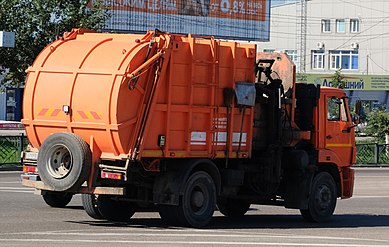
Garbage truck KAMAZ on the streets of Ulan-Ude
Pneumatic collection [edit]

Volvo pneumatic collector used for "waste matter suction"
Pneumatic collection trucks have a crane with a tube and a mouthpiece that fits in a hole, usually subconscious under a plate under the street. From here information technology will suck upwards waste material from an cloak-and-dagger installation. The organization unremarkably allows the commuter to "choice up" the waste matter, even if the admission is blocked past cars, snow or other barriers.

Grapple trucks [edit]
Grapple trucks enable the drove of bulk waste. A large percentage of items in the solid waste matter stream are likewise large or too heavy to exist safely lifted by hand into traditional garbage trucks. These items (furniture, large appliances, branches, logs) are chosen beefy waste or "oversized." The preferred method for collecting these items is with a grapple truck. Grapple trucks have hydraulic knucklebooms, tipped with a clamshell saucepan, and usually include a dump trunk or trailer.
Curlicue-offs [edit]
Gyre-offs are characterized by a rectangular footprint, utilizing wheels to facilitate rolling the dumpster in place. The container is designed to be transported by special curlicue-off trucks. They are relatively efficient for bulk loads of waste material or extremely heavy loads of construction or demolition debris.[xi]
Bin tipper [edit]
A bin tipper is a machine which mechanically lifts and inverts bins for the purpose of emptying them. They are ofttimes components of larger machines such as garbage trucks, or tin exist 'standalone' or mobile units.[12] Bin tippers ordinarily accept a steel frame, guarding and cradle, with a motor or crank-handle driving a lifting mechanism, which may exist hydraulic or chain operated. Bins are placed into the motorcar, then lifted and inverted over the destination receptacle, assuasive the contents to be emptied past gravity.
A side-load bin tipper was fitted to a garbage truck as early every bit 1929, past the Heil company in America. In the 1950s the Dempster Dumpmaster popularized the forepart-end loader variant, with bins beingness tipped over the cab of the truck. Both types of integrated bin tipper are now common on municipal refuse collection trucks. Standalone bin tippers adult later, with the release of a machine called the Simpro Ezi-Dump in 1990.
The employ of bin tippers and other lifting aids has been stimulated in contempo years past research linking heavy transmission lifting with musculoskeletal disorders;[13] [14] some regime organisations,[fifteen] schools[16] and companies now prohibit emptying bins by hand. Health and safety concerns have also driven the adoption of bin tippers in the manufacturing, food-processing and structure industries.[17]
See besides [edit]
- Dump truck
- Beach cleaner
- Garbage scow
References [edit]
- ^ "Motor-Cars for Dust Drove", The Automotor and Horseless Carriage Journal, February 1897, p192
- ^ City of Scottsdale, Arizona, Solid Waste matter Management Sectionalisation - Classic Refuse Trucks, November six, 2005.
- ^ Geroux, Zachary; Voytko, Eric. "The E'er Expanding History of the Forepart Load Reject Truck". Retrieved ten September 2014.
- ^ "Classic Turn down Trucks Front LOADERS". www.classicrefusetrucks.com . Retrieved eleven April 2018.
- ^ "Heil Expands Operate-At-Idle Offering". four February 2005. Retrieved 10 September 2014.
- ^ "Heil Formula 5000 Rear Loader using lifter". YouTube. Archived from the original on 2021-12-12.
- ^ "How garbage truck is made - material, used, parts, components, steps, industry, machine". world wide web.madehow.com . Retrieved xi Apr 2018.
- ^ Sean, Murphy (3 April 2014). "Automatic Garbage Collection". Retrieved 10 September 2014.
- ^ Marc J. Rogoff (2014). "Solid waste product drove automation in the United states of america". Waste Direction & Research. 32 (11): 1031–1033. doi:10.1177/0734242X14558164. PMID 25378253. S2CID 29990805.
- ^ "The Evolution of 21st Century Garbage Trucks". big-ben.co . Retrieved eleven April 2018.
- ^ "Waste Truck Collection Systems". TruckWorld.com.au. 11 February 2015. Retrieved 12 May 2015.
- ^ "Bin Tippers From Solus Group On Display At WasteExpo Trade Show". solusgrp.com . Retrieved xi April 2018.
- ^ "OSH in figures: Work-related musculoskeletal disorders in the EU - Facts and figures | Condom and wellness at piece of work European union-OSHA".
- ^ Velasco Garrido, M; Bittner, C; Harth, Five; Preisser, AM (2015). "Health condition and health-related quality of life of municipal waste collection workers - a cantankerous-sectional survey". J Occup Med Toxicol. x: 22. doi:10.1186/s12995-015-0065-six. PMC4493964. PMID 26155300.
- ^ "Archived re-create" (PDF). Archived from the original (PDF) on 2016-07-05. Retrieved 2017-ten-04 .
{{cite web}}: CS1 maint: archived copy as title (link) - ^ http://www.gaps.qld.edu.au/Discover%20Us/Documents/Manual-Handling-of-Wheelie-Bins.pdf[ blank URL PDF ]
- ^ "Dumpmaster used to reduce manual handling All-time Practice Hub". ccsbestpractice.org.united kingdom of great britain and northern ireland . Retrieved 11 April 2018.
External links [edit]
- History of refuse drove - historical information and many pictures
- Classicrefusetrucks.com - history of mechanical refuse collection equipment
Source: https://en.wikipedia.org/wiki/Garbage_truck
0 Response to "Again They Always Been Junker Trucks When They Were Coming Out in the 70s"
Post a Comment